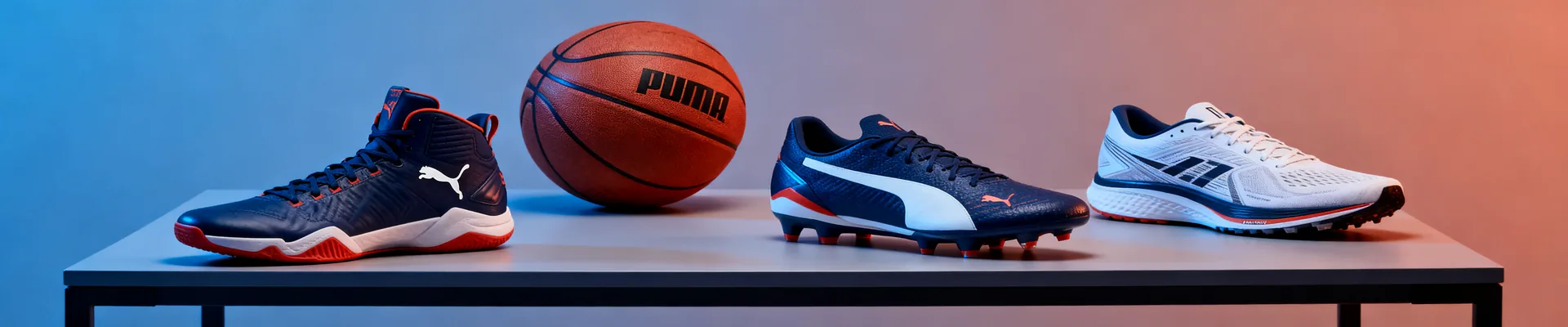
- Step 1: Define the use case and quantity — and write it down
- Step 2: Pull the full spec sheet — and read the terrain row
- Step 3: For soccer cleats, confirm the manufacturer's stud configuration
- Step 4: For Puma basketball shoes, match the model to play style and check the men's sizing grid
- Step 5: For running shoes, read the specification guide before trusting a marketing page
- Step 6: Verify bulk shoe care compatibility with your upper materials
- Step 7: Run a sample order before you commit to bulk
- Step 8: Lock down invoicing, PO, and return terms in writing
- Step 9: Schedule delivery against your actual use date, not your order date
-
What I'd flag last — the mistakes that cost the most
I'm the office administrator for a 200-person company, and I handle all equipment ordering for our three employee sports clubs — a co-ed soccer league, a weekend basketball group, and a 60-member running club. All told, I process around 70 orders a year, give or take a few, spread across 11 vendors. I report to both our operations lead and our finance team, which means every mistake gets seen twice.
Most of it is kinda unglamorous — office supplies, printer toner, the occasional pallet of coffee. But three times a year I'm responsible for outfitting the clubs, and that's where I've made my real mistakes. The ones that end up in a finance email.
I built this checklist after a $2,400 rejection. In 2023 I sourced 30 pairs of basketball shoes from a new supplier who couldn't provide a proper invoice — handwritten receipt only. Finance rejected the expense report. I ate the cost out of the department budget. That was the last time I ordered anything without a written invoice agreement.
There's a 9-step process below. It takes about 40 minutes if you're organized. It covers soccer cleats, Puma basketball shoes, running shoes, and bulk shoe care — the four categories I get asked about most. Skip any step and you'll usually find out why it mattered three weeks later.
Step 1: Define the use case and quantity — and write it down
Before you look at a single product page, write out three things: who's wearing what, on which surface, and how many. "Soccer cleats" isn't a spec. "Size 8–11 men's, FG studs, 24 pairs for a co-ed rec league on natural grass" is a spec.
The reason this matters: I once ordered 18 pairs of running shoes for the club based on a vague "most of us are size 9–10" and ended up with 6 pairs in the wrong size. Returns cost us $180 in restocking fees plus two weeks. Now I collect sizes in a shared form before I open any supplier catalog.
Checkpoint: Do you have a written size and quantity list before you start?
Step 2: Pull the full spec sheet — and read the terrain row
This is where most buyers trip up. A shoe spec sheet doesn't just list size, color, price. It lists stud or grip configuration, upper material, weight, and the surface the model is approved for. If you skip that row, you'll get firm-ground studs for an artificial-grass surface, or the reverse.
Same goes for basketball. A Puma basketball shoes spec sheet should tell you whether the model is built for indoor hardwood, outdoor concrete, or both. The grip pattern on an outdoor shoe isn't the same as on an indoor one. If the listing doesn't specify, email the supplier and ask. (Should mention: I've had three suppliers refuse to answer this — all three turned out to be drop-shippers, not manufacturers.)
Checkpoint: Can you state the surface and the stud or grip type in one sentence?
Step 3: For soccer cleats, confirm the manufacturer's stud configuration
When you're sourcing from a soccer cleats manufacturer, surface compatibility is non-negotiable. There are four common configurations:
- FG (firm ground) — natural grass, standard studs
- AG (artificial grass) — shorter, more numerous studs
- Turf (TF) — short rubberized knobs, for older synthetic surfaces
- Indoor (IN) — flat rubber outsole, no studs
Using FG on artificial grass will chew up your players' knees. Using turf on natural grass means no traction. I've seen both happen, and I've had to explain both to my operations lead. When I compared our 2024 season (proper AG cleats) to our 2023 season (mixed FG and AG — no real logic to it) side by side, the injury complaints in 2023 were double. That was the moment I stopped treating "cleats are cleats" as an acceptable shortcut.
Checkpoint: Does every pair in the order match the surface it'll be played on?
Step 4: For Puma basketball shoes, match the model to play style and check the men's sizing grid
If you're looking at basketball shoes Puma All-Pro Nitro 2 men's, know what you're buying. The All-Pro Nitro line is a performance basketball shoe — that's the intended use. It isn't a casual sneaker, and it isn't built for the same kind of outdoor concrete abuse as some of Puma's other models.
Two things I verify every time. First, men's vs. women's sizing — a women's 8 is roughly a men's 6.5, so a co-ed group needs either a split order or a conversion table. More than one supplier has gotten this wrong for us. Second, the return window. Basketball shoes have a break-in period, and if the first five players report a tight toe box you need a return path that doesn't cost you 30% of the order. I ask for written confirmation of the return policy before I pay.
Even after choosing the Puma model our players had been asking for, I kept second-guessing. What if the sizing ran narrow like I'd read on some forum? The ten days until delivery were stressful. It ended fine — sizing was standard — but I wouldn't want to go through that again without a written confirmation of the return terms in advance.
Checkpoint: Do you have the sizing conversion and the return policy in writing?
Step 5: For running shoes, read the specification guide before trusting a marketing page
Running shoes are the category where the marketing copy is the least helpful. Any running shoes specification guide worth reading will list three numbers: stack height, heel-to-toe drop, and weight. Per FTC advertising guidance (ftc.gov), performance claims like "support" or "cushioning" need to be substantiated with evidence — but as a buyer you can't rely on enforcement to protect you. You have to read the specs yourself.
Here's how I check:
- Stack height — the height of the midsole, usually 24–40mm. Higher stack means more cushioning, less ground feel.
- Drop — the difference between heel and toe stack. A 12mm drop feels very different from a 4mm drop. If your group has mixed experience levels, don't order a single drop for everyone.
- Weight — usually 220–290g per shoe for a men's size 9. Heavier than that and you're buying a support shoe, not a neutral one.
I email the supplier these three specs before I order. (Should mention: the suppliers who couldn't provide them were drop-shippers. The ones who did are the ones I re-use.)
Checkpoint: Do you have stack height, drop, and weight for every model on your list?
Step 6: Verify bulk shoe care compatibility with your upper materials
This is the step almost everyone skips. Bulk shoe care kits are not one-size-fits-all. A cleaner formulated for leather uppers will strip the water-repellent finish off a knit running shoe. A product formulated for mesh will leave streaks on suede. If you're buying in bulk for a mixed group — and you almost always are — you need a compatibility matrix before you order.
The other thing I check is claims. Per the FTC Green Guides (16 CFR Part 260), environmental claims like "recyclable" or "eco-friendly" on shoe care products need substantiation. A product "made with recycled materials" should specify what percentage — a 5% recycled-content claim and a 70% claim are very different things, and the FTC has taken action on both.
My rule: no bulk shoe care order without a written material list (what the product is safe on) and a documented sustainability claim on file. (Which, honestly, has narrowed my supplier list from six to two. That's fine.)
Checkpoint: Do you have a written material compatibility list, not just a marketing bullet?
Step 7: Run a sample order before you commit to bulk
If a supplier is new to you, order two units before you order twenty. It costs more per unit. It's worth it. The $60 I spent on a sample order in 2023 saved me from a $1,900 mistake — the sample came in a shade of gray noticeably different from the catalog photo, and I was able to flag it before bulk delivery.
Sample orders also flush out the supplier's paperwork before the money is big. If they can't produce a proper invoice for a two-unit order, they won't be able to produce one for a twenty-unit order either.
Checkpoint: Have you tested the supplier's invoicing on a small order first?
Step 8: Lock down invoicing, PO, and return terms in writing
I mentioned this at the top, but it deserves its own step. Before any bulk order, I want four things in writing: the invoice format (a standard commercial invoice, not a receipt), the purchase order number reference on that invoice, the return window with the restocking fee stated, and the delivery window with a late-delivery clause if the supplier will agree to one.
5 minutes of verification beats 5 days of correction. I have never regretted asking for the invoice template before ordering. I've regretted not asking twice.
Checkpoint: Do you have everything above in a single emailed confirmation?
Step 9: Schedule delivery against your actual use date, not your order date
Two words: buffer days. If your soccer season starts on March 15, don't schedule delivery for March 15. Schedule it for March 8 at the latest, and confirm in writing that the supplier can meet that window. Bulk orders can be held up by customs, weather, or stock allocation — and none of those are things you can fix the week before your players need their cleats.
We've processed maybe 70 orders this year. Maybe 65, I'd have to check the system. The only deliveries that have caused a problem were the ones where I didn't leave a buffer.
Checkpoint: Is the delivery date at least 5 business days before your first use date?
What I'd flag last — the mistakes that cost the most
Three things I'd highlight for anyone running this checklist for the first time:
- Surface before color. The single biggest mistake I've seen (and made) is choosing on appearance first. The stud configuration matters more than the colorway, every time.
- Sizing grid before unit price. A "cheaper" supplier that ships the wrong women's conversion will cost you more in rework than the $2 per unit you saved.
- Invoice format before delivery date. If the supplier can't produce a clean invoice, none of the rest matters. Your finance team will reject it and you'll be holding inventory you can't pay for.
This checklist isn't a substitute for judgment. Some suppliers will fail on one step and still be the right partner — I've worked with a small supplier who took three days to produce an invoice but never once shipped a wrong size in two years. But you need to know which steps you're skipping, and why. That's the whole point.

I’m Jane Smith, a senior content writer with over 15 years of experience in the packaging and printing industry. I specialize in writing about the latest trends, technologies, and best practices in packaging design, sustainability, and printing techniques. My goal is to help businesses understand complex printing processes and design solutions that enhance both product packaging and brand visibility.
Leave a technical comment
Do not include credentials, personal data or confidential factory information.